Water Rights & Security for Tamil Nadu Farmland | Vinoth Kumar
Evaluating Water Security: Farmland Water Rights in Tamil Nadu
Securing a premium piece of agricultural land or designing a luxury farmhouse layout across Coimbatore or the Nilgiri foothills requires looking past simple groundwater availability. While drilling a successful borehole is important, understanding the legal framework surrounding farmland water rights Tamil Nadu policies is what guarantees your estate’s survival. Many investors overlook historical distribution layouts and local sharing agreements, leading to costly legal disputes with surrounding agriculturalists.
Understanding Local Water Distribution & Sharing Laws
In Tamil Nadu, water access is often tied directly to traditional community agreements and historical land deeds. Even if your field sits directly next to a natural canal or stream, you do not automatically possess unrestricted extraction privileges. You must explicitly verify your property’s standing regarding riparian rights and recorded source access.
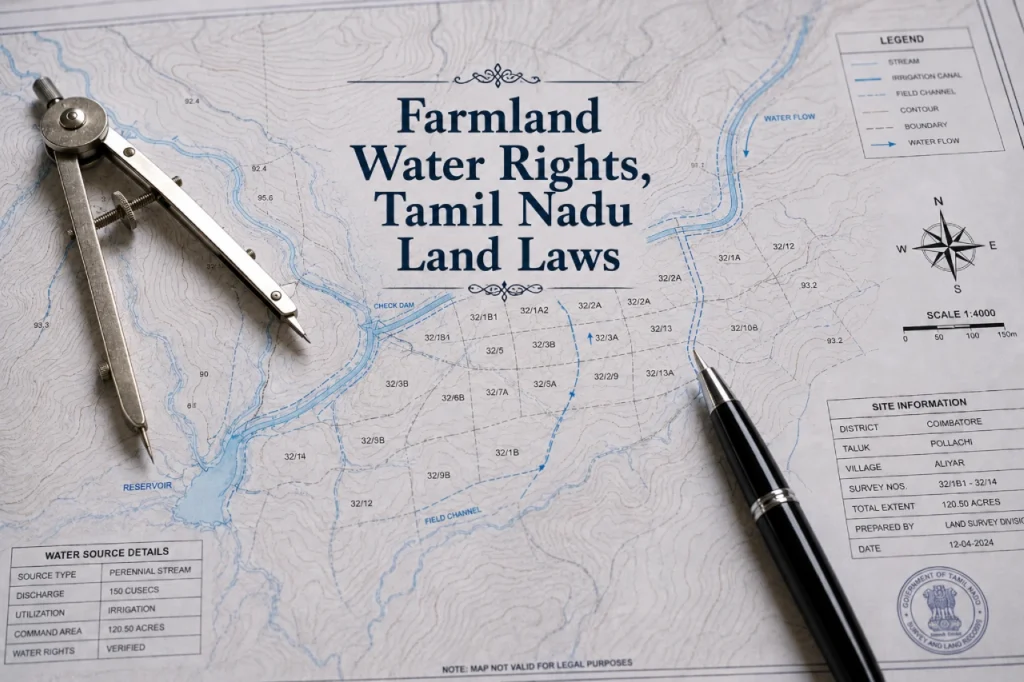
One of the most critical elements to review during your property vetting phase is the presence of historical channel paths (வாய்க்கால் – Vaikaal rights). If an official revenue map reveals a registered irrigation channel cutting through or bordering your boundary, blocking or diverting that path illegally is a major offense. Working with an experienced farmhouse land consultant ensures these intricate distribution lines are fully analyzed before you commit capital.
Key Factors in Farmland Water Security
- Riparian Water Sharing: Ensure your title documents explicitly state your share of water from common wells, open tanks, or river distributaries.
- Panchayat & Free Power Rules: Review local guidelines for scaling up water extraction or transferring existing agricultural power connections seamlessly.
- Drip-Irrigation Guidelines: Check eligibility for state-level micro-irrigation layout incentives to maximize your water conservation footprint.
Balancing Groundwater Tables and Storage Layouts
Relying solely on deep borewell lines without an integrated open storage or harvesting strategy leaves your estate highly vulnerable to dry seasons. To build a truly sustainable weekend retreat or plantation asset, your structural blueprint must account for the natural slope of the land to feed rainwater harvest ponds or recharge shafts. This proactive planning protects your vegetation layers and ensures a continuous water supply to your farmhouse structures year-round.
Strategic Advice: Always cross-check the historical water levels of a village across a 10-year cycle. A field that shows rich surface water during the monsoon may face severe supply drops during peak summer months if it lacks deeded sharing rights.
Securing Professional Layout Vetting
Verifying farmland water rights Tamil Nadu documentation requires a careful audit of old parent deeds, village revenue sketches, and physical on-field tracing. Making sure your water access is legally protected gives you total peace of mind as you begin developing your layout. Learn more about our specialized risk mitigation standards directly on my about farmhouse land consultant blueprint section.
If you are analyzing a specific land parcel in the foothills or need an independent, comprehensive water security audit, technical layout verification, or deep legal title search, let’s look over your survey numbers together to build a protected asset blueprint.
Ready to plan your estate infrastructure or need professional land vetting?
Click Here to Contact Our Farmhouse Specialist Team Directly



Leave a Reply
You must be logged in to post a comment.